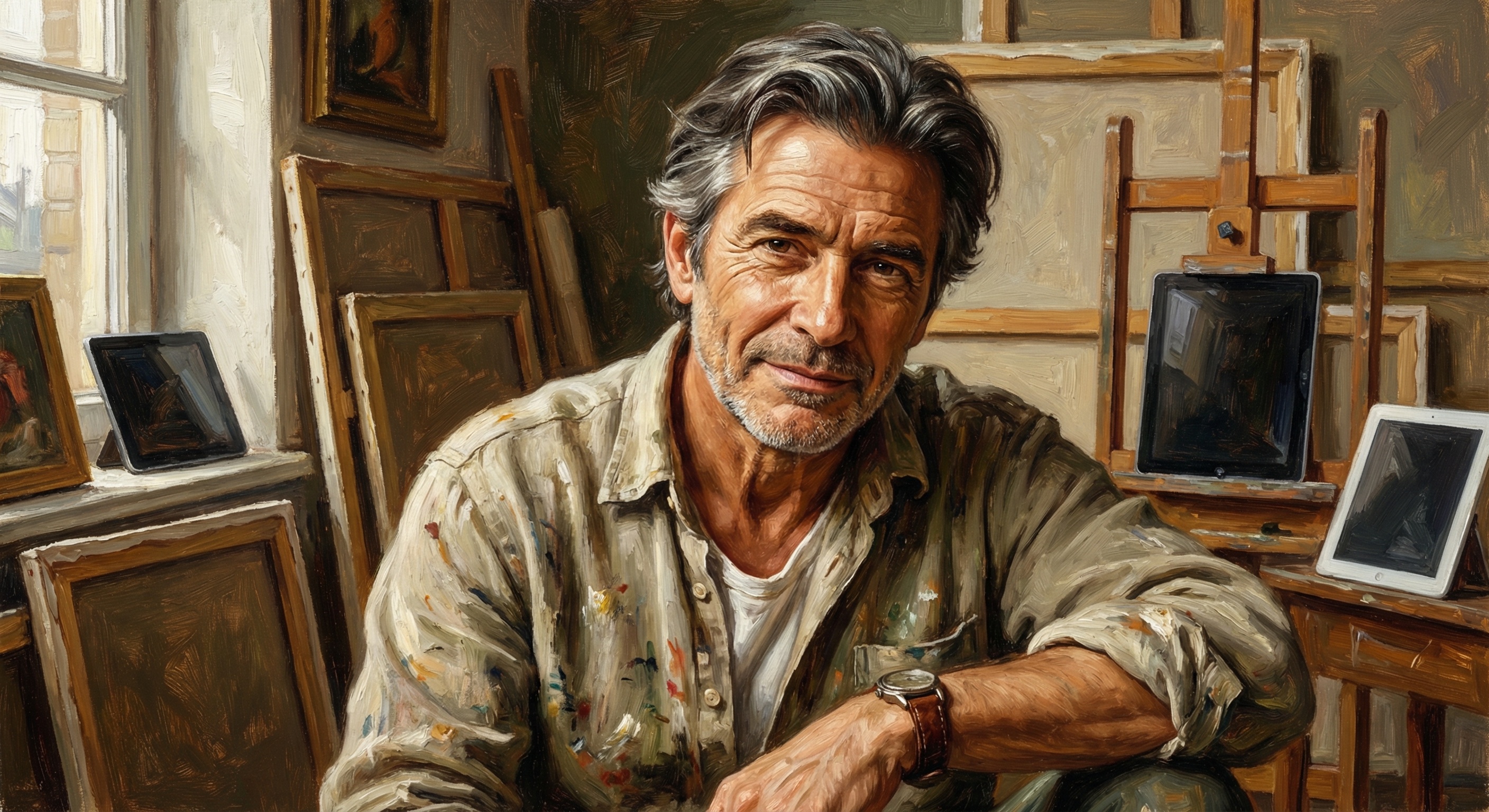
The Artist
Jacque Dubois was born in 1969 in Arles, in the sun-drenched south of France, where the same light that once drew Van Gogh still pours through the windows of stone farmhouses at dawn. He grew up surrounded by art — his mother painted watercolors of the Camargue wetlands, his grandfather restored frescoes in village churches across Provence. By twelve, Jacque was sketching in charcoal on the banks of the Rhône, selling small portraits to tourists for pocket money. By sixteen, he was painting commissioned pieces for local restaurants and inns.
He studied at the École des Beaux-Arts in Lyon from 1987 to 1991, immersed in oil painting, life drawing, and art history during what he calls "the last pure years before screens changed everything." His professors recognized a rare gift — not just technical skill, but an instinct for light. "Dubois doesn't paint objects," one instructor wrote in his final evaluation. "He paints the space between the light and the thing it touches."
After graduating, Jacque spent nearly two decades as a traditional oil painter — exhibiting in galleries across Provence, Lyon, Geneva, and Lausanne. He painted sacred commissions for parish churches, landscapes for collectors, and portraits for anyone who would sit still long enough. He lived modestly, worked relentlessly, and built a reputation in southern France as a painter's painter — someone other artists respected even if the broader art world never made him famous.
In his late forties, with over thirty years of brush in hand, Jacque discovered digital art tools that would change his life. Where younger artists saw a shortcut, he saw something different — a medium that could finally keep pace with his imagination. "I have spent my whole career limited by drying time," he once joked. "Now I am limited only by vision." He threw himself into mastering generative and digital techniques with the same discipline he brought to oils, spending years learning the craft before showing a single piece.
In 2022, at 53, Jacque made the move that surprised everyone who knew him — he left France for Texas. He'd visited San Antonio on a painting trip years earlier and couldn't shake the light. "The Hill Country at golden hour reminds me of Provence," he says. "But bigger. Everything in Texas is bigger — the sky, the land, the welcome." Locals started calling him "JD" within his first month. The name stuck. So did he.
Today, at 57, Jacque — JD to his neighbors, Dubois to collectors — works from a converted garage studio in Texas, creating digital fine art that draws on a lifetime of classical training. His collections span sacred art, American patriotic imagery, watercolor landscapes, Art Nouveau parables, folk art, and contemporary abstracts. Every piece carries the same philosophy he learned watching his grandfather work on crumbling chapel walls in Provence: art exists to move the soul.
"I painted with oils for thirty years. I know what light does to a face, how shadow falls across stone, what colors the human eye craves. The tool changed. The eye did not. That is still the artist's work. That will always be the artist's work."
— Jacque Dubois, 2025
By the Numbers
Collections
Each collection explores a theme through a distinct visual language.
Christ in Light
Luminous depictions of the Savior — warmth, divinity, and graceBold Sacred
Vivid, contemporary sacred imagery with dramatic colorArt Nouveau Parables
Biblical parables reimagined in ornate Art Nouveau styleLuminous
Light-drenched scenes of faith, nature, and spiritual peaceAmerican Patriotic
Eagles, flags, and the enduring spirit of American freedomFolk Art Landscapes
Pastoral Americana — farmsteads, prairies, and quiet churchesArt Nouveau Sacred
Classical sacred themes with flowing Art Nouveau eleganceContemporary Parables
Modern, bold retellings of timeless biblical storiesGeometric Sacred
Sacred geometry meets spiritual art — temples, light, patternWatercolor
Soft pastel landscapes inspired by Psalms and natureThe Creative Process
Every Dubois piece goes through the same deliberate process — the one he developed over thirty-five years of learning what makes a painting worth looking at twice.
Concept & Sketch
Every piece starts the old-fashioned way — a rough sketch, a color study, notes on mood and meaning. Jacque draws from scripture, landscape memory, art history, and personal experience to define the emotional core of each work.
Generative Exploration
Using carefully engineered prompts informed by his classical training, Jacque generates dozens of variations — exploring compositions, lighting, and palettes. His understanding of color theory and form guides every iteration.
The Artist's Eye
This is where thirty-five years of training matters most. Jacque evaluates each variation for compositional balance, emotional truth, color harmony, and spiritual resonance. Fewer than one in fifty survive this stage.
Gallery & Print
Selected works are refined to museum-quality resolution, signed with Jacque's calligraphic mark, and added to the permanent collection. Each piece is available as archival canvas wraps, framed prints, and metal prints.
On the New Medium
Jacque is often asked about his relationship with digital tools — whether they diminish the art, whether it's "real." He answers the same way every time, usually with a shrug that's unmistakably French: "I spent thirty years learning to mix oils. How cadmium yellow behaves against ultramarine blue. How light falls across a face at five in the afternoon versus seven. That knowledge didn't disappear when I picked up a new tool. It became more powerful."
He has little patience for the debate. "A camera did not replace the painter. Photography became its own art. The artists who understand both the classical and the digital — we are the ones who will define what comes next. I have been preparing for this my entire life. I just didn't know it."
What sets Jacque apart is simple: he has the eye. Thirty-plus years of studying composition, color, light, and human emotion. He knows when something is beautiful. He knows when it's almost beautiful — and why. That instinct can't be taught in a weekend tutorial. It's earned one brushstroke at a time, over decades.
"My grandfather restored frescoes with brushes made of boar hair in churches that had stood for five hundred years. I create with tools that didn't exist five years ago, for people I'll never meet. The tools change. The eye that knows beauty — that is eternal."
— Jacque Dubois, 2024